
AI-Powered Automation
Agentic Workflows
Intelligent Identity Automation Powered by AI
A Python-based, comprehensive agentic AI workflow system that brings intelligence, adaptability, and efficiency to modern identity workflows. Orchestrate complex processes using a modular, context-aware framework.
Next-Generation Identity Automation
What Are Agentic Workflows?
Agentic Workflows represent the next evolution in identity automation—combining the power of Large Language Models (LLMs) with enterprise-grade workflow orchestration. These intelligent workflows understand natural language requests, make context-aware decisions, and orchestrate complex multi-step processes autonomously. Built on EmpowerID's proven low-code/no-code platform, Agentic Workflows transform how organizations manage identity governance, access requests, and privileged access management.
End-to-end workflow automation
Context-aware task execution
Adaptability to dynamic environments
Seamless integration
Scalability for enterprise
AI-empowered decisions
Framework Architecture
How Agentic Workflows Are Built
Agentic workflows are constructed using a series of activities, line functions, and transitions that orchestrate tasks performed by autonomous agents. The framework supports single-agent, multi-agent, hierarchical, and sequential workflow patterns.
Activities
Individual units of work within the workflow. Each activity encapsulates a task or process that an agent must execute.
- User provisioning and validation
- Data processing and transformation
- Notifications and communications
Line Functions
Define transitions between activities based on conditions or workflow logic, determining the path the workflow takes.
- Conditional transitions
- Parallel execution paths
- Dynamic flow control
Workflow Context
Encapsulates all relevant information about the workflow's execution state, including chat history and transitions.
- State management across activities
- Conversation history tracking
- Pause and resume capabilities
Workflow Control Flow Patterns
Single-Agent
Straightforward tasks completed by a single agent without external dependencies
Multi-Agent
Multiple agents collaborate and exchange information for complex scenarios
Hierarchical
Command structure where higher-level agents coordinate lower-level agents
Sequential
Tasks completed in specific order for predictable outcomes and debugging
Intelligent Coordination
Multi-Agent Workflow Orchestration
Supervisor AI agents coordinate specialized task agents to handle complex identity workflows with knowledge bases, strategic planning, reflection capabilities, and multi-agent collaboration orchestration
User Interaction
Natural language requests through conversational interfaces integrated with Microsoft Teams, Slack, or custom chatbots
Supervisor AI Agent
Coordinates multiple specialized agents with knowledge bases, strategic planning, reflection capabilities, and multi-agent collaboration orchestration
Specialized Task Agents
Access Request Agent, JIRA Issue Agent, and custom domain-specific agents—each with dedicated knowledge bases and specialized tools
Enterprise Infrastructure
High-Level Architecture
Enterprise-grade infrastructure connecting AI agents, orchestration platforms, and EmpowerNow—the identity control platform for governed runtime execution
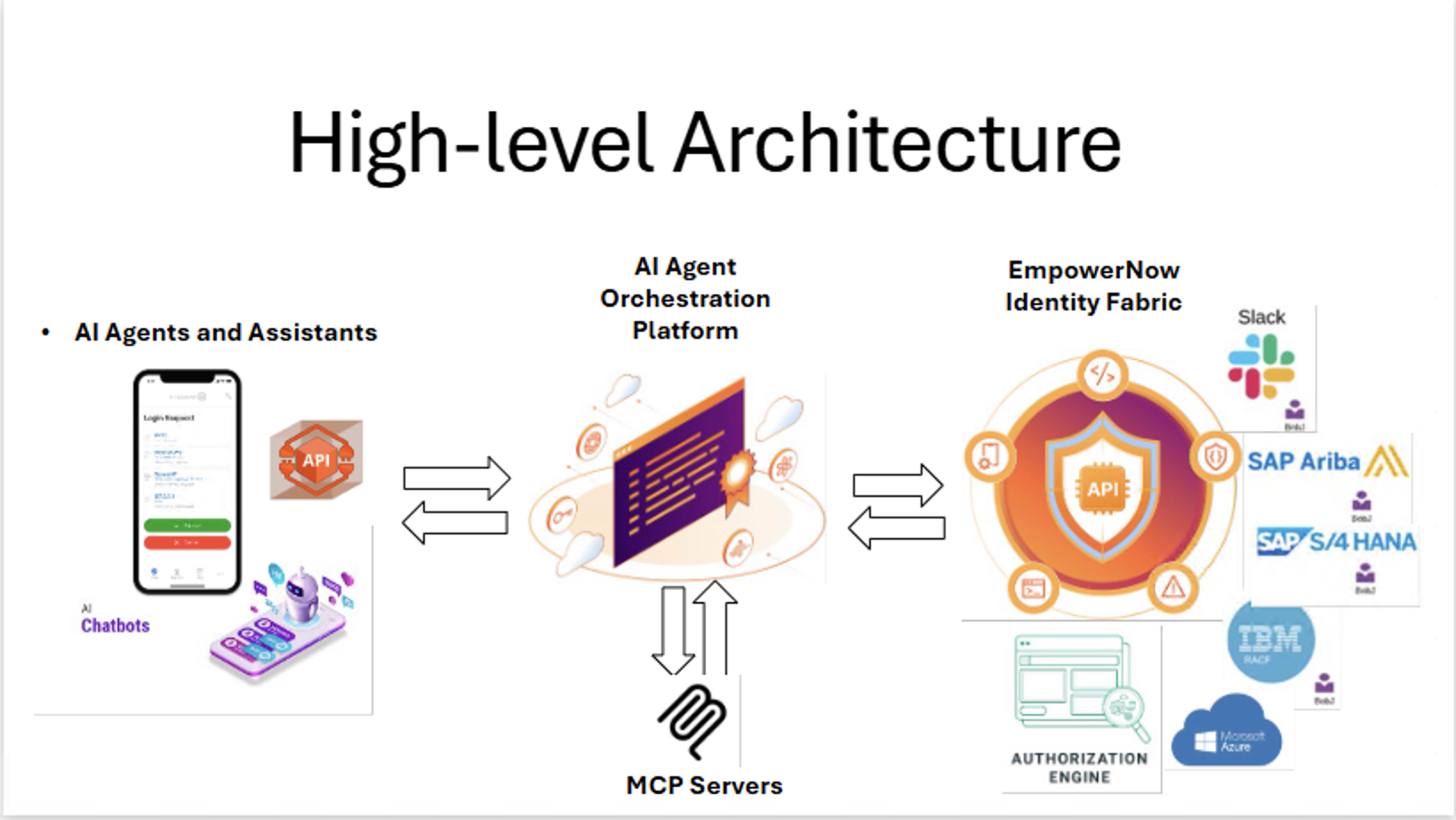
AI Agents & Assistants
Chatbots and AI-powered interfaces provide natural language access to identity workflows
- Microsoft Teams integration
- Slack integration
- Custom API endpoints
Orchestration Platform
Python-based Agent Orchestration Service manages workflow execution, state persistence, and multi-agent coordination
- MCP Servers integration
- Stateful workflow management
- Multi-agent coordination
EmpowerNow
The identity control platform for SAP migration, IGA modernization, and AI agent runtime control—connecting enterprise systems with governed authorization and proof
- SAP, Azure, Slack, IBM integrations
- Authorization Engine (RBAC/PBAC)
- 300+ production-tested connectors
Development Tools
Three Powerful Interfaces
Build, test, and deploy agentic workflows through conversational interfaces, visual designers, or direct Python code
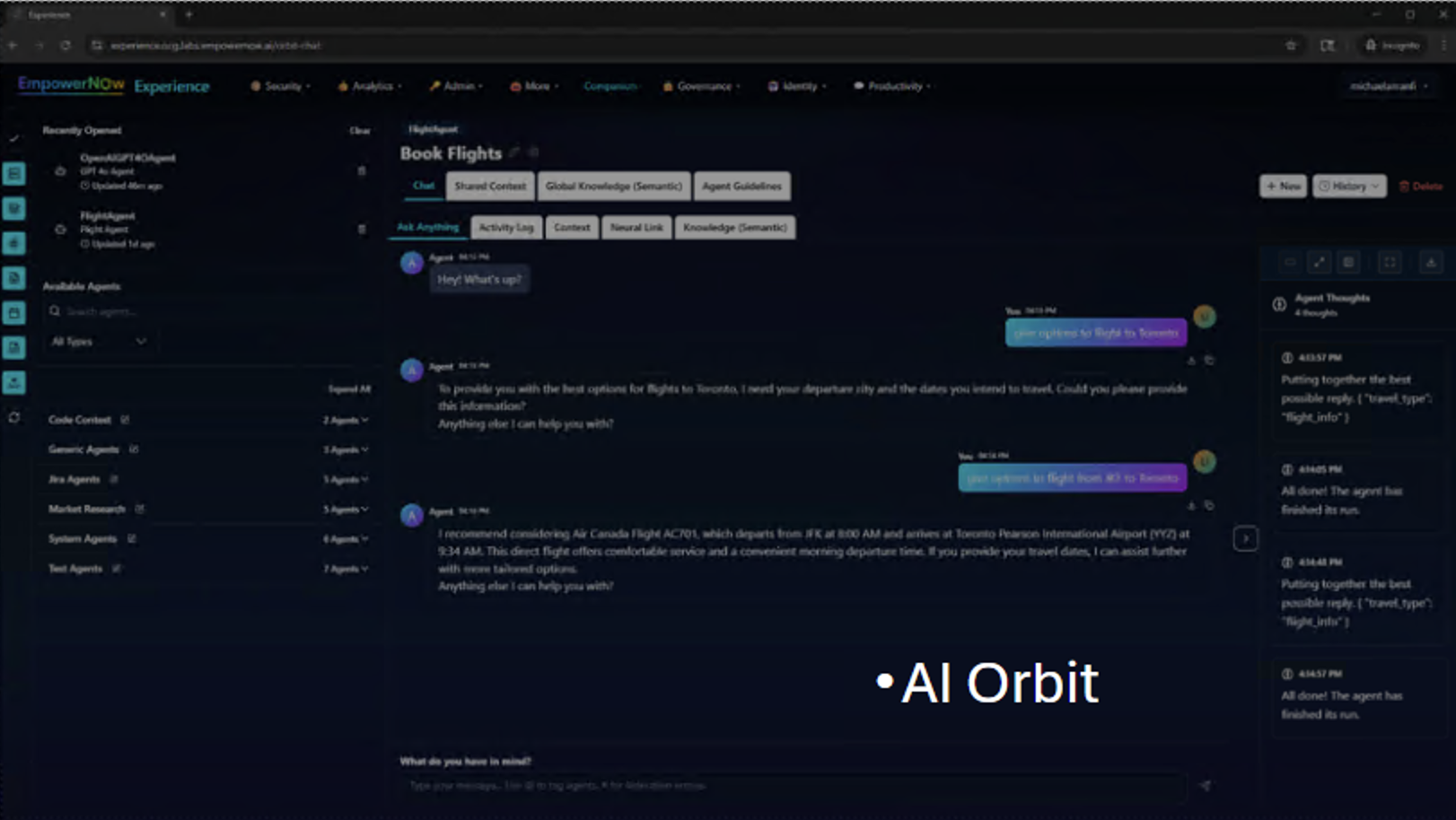
Conversational Workflow Interface
Chat with AI agents to execute complex identity workflows through natural conversation. AI Orbit provides an intuitive interface for interacting with workflows, viewing conversation history, and tracking agent decisions in real-time.
- Multi-turn conversations with context retention
- Tool call visualization and agent thought processes
- Shared context and knowledge base integration
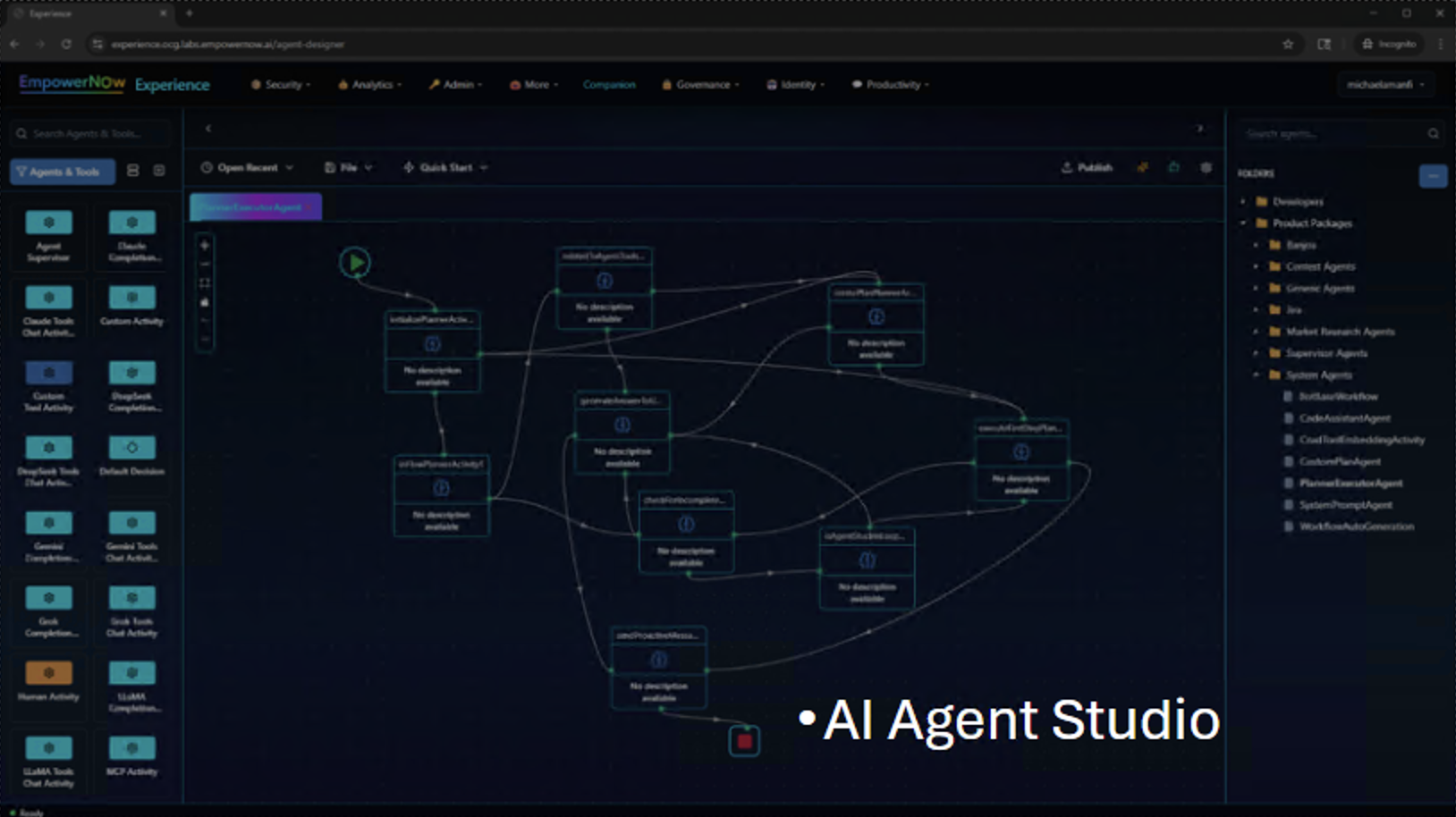
Visual Workflow Designer
Build sophisticated multi-agent workflows using drag-and-drop visual design. AI Agent Studio provides a comprehensive development environment for creating, testing, and deploying agentic workflows without deep coding expertise.
- Visual workflow designer with real-time chat testing
- Pre-built agent templates and tool libraries
- Version control and deployment management
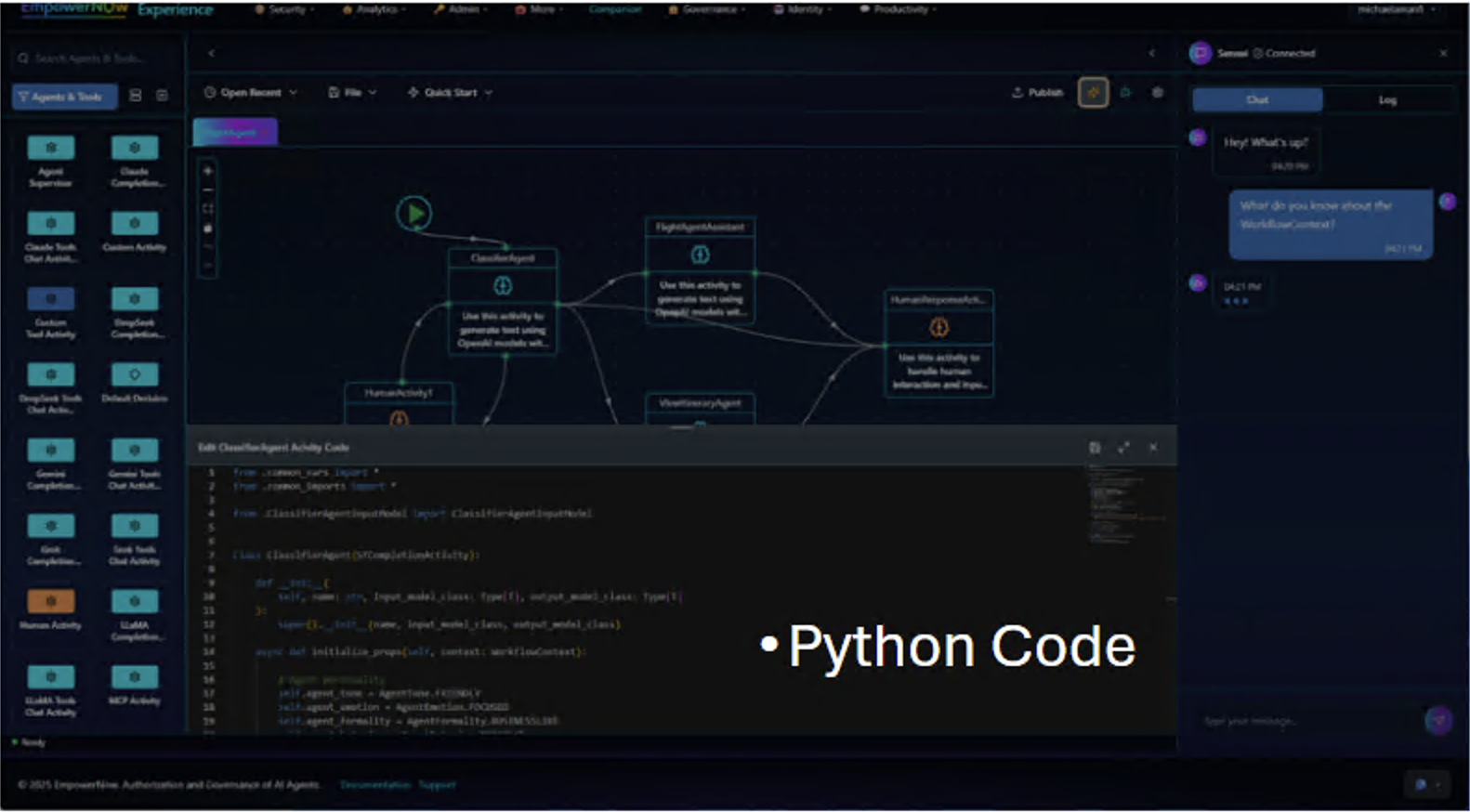
Full Code Control
For advanced scenarios, access the full Python codebase to customize activity functions, create custom tools, and integrate with any external system. Built on Pydantic for type safety and FastAPI for modern REST APIs.
- Python activity functions with async/await support
- Pydantic models for type-safe data validation
- Built-in LLM integration methods for GPT-4 and Ollama
AI-Powered Intelligence
Working with LLMs and Tools
The Agentic Workflow System integrates seamlessly with Large Language Models and provides a robust tools architecture for interacting with external systems, databases, and APIs
Built-In LLM Activities
The system includes specialized activities designed to interact with LLMs such as OpenAI's GPT and Ollama models, enabling workflows to leverage advanced natural language processing capabilities.
CompletionActivity
Interact with OpenAI models using system and user prompts with grounding context
- • System & user prompt configuration
- • Grounding context support
- • Multiple model selection
ToolsChatActivity
Enable LLM to call external tools based on responses for interactive workflows
- • Tool call detection & execution
- • Chat history management
- • Multiple tool handling
OllamaChatActivity
Interact with Ollama models for on-premise LLM deployments
- • Ollama model integration
- • Tool call support
- • Resume after tool execution
Tools Architecture
Tools are specialized ActivityFunction subclasses that enable workflows to interact with external resources, systems, and APIs. Each tool encapsulates specific functionality in a modular, reusable way.
Tool Implementation
Tools are built as specialized ActivityFunction subclasses with structured input/output models using Pydantic for type safety and validation.
- Pydantic models for input/output validation
- run() and resume() methods for execution lifecycle
- Integration with WorkflowContext for state management
LLM-Driven Tool Calls
LLMs can dynamically invoke tools based on natural language requests, with the system handling tool discovery, parameter passing, and response integration.
- Automatic tool schema generation
- Natural language to function parameter mapping
- Queue-based response handling
Example Tool Use Cases
User Provisioning
Create accounts, assign roles, set permissions
Application Access
Retrieve app lists, grant access, manage subscriptions
External APIs
JIRA, ServiceNow, custom REST endpoints
Data Queries
Database lookups, reporting, analytics
Conversation History Management
The system manages conversation histories at both workflow and activity levels, providing context continuity across LLM interactions while optimizing memory usage.
Workflow-Level History
Global context spanning multiple activities, ensuring continuity across the entire workflow execution
- • Persistent across activity transitions
- • Shared context for dependent activities
- • Memory management with configurable limits
Activity-Level History
Localized context for specific activities, reducing memory overhead while maintaining relevant conversational context
- • Scoped to individual activity execution
- • Automatic cleanup after completion
- • Optional transfer to workflow history
Core Capabilities
Natural Language Processing
Interact with workflows using conversational language through GPT-4, Ollama, and other LLMs
Context-Aware Decisions
AI agents understand business context and organizational policies for intelligent automation
Tool Integration
Dynamic integration with ServiceNow, SAP, Azure AD via 300+ pre-built connectors
Policy-Driven Automation
Enforce Zero Trust policies, SoD rules, and compliance requirements automatically
Stateful Execution
Workflows maintain state and can pause, wait for approvals, and resume seamlessly
Low-Code/No-Code Development
Visual Workflow Studio enables rapid development without extensive coding
Enterprise Use Cases
Real-world applications of agentic workflows in identity and access management
Conversational User Provisioning
"Create an account for John Smith in Finance with access to SharePoint and CRM." The agent validates inputs, creates accounts, assigns roles, and grants access through natural conversation.
Intelligent Access Requests
"I need access to the Q4 financial reports." The AI agent determines resources, checks policies, routes approvals, and grants access while enforcing SoD and compliance rules.
Automated Compliance Remediation
When SoD violations are detected, agentic workflows analyze context, recommend remediation, and automatically revoke toxic access while logging audit trails.
Just-in-Time Privileged Access
"I need admin rights on the production database for 2 hours." The AI evaluates requests, checks policies, grants time-limited access, and automatically revokes it.
Why Agentic Workflows Matter
Reduce Manual Effort
Automate repetitive identity tasks. AI agents handle routine provisioning, access requests, and approvals autonomously.
Faster Time-to-Value
Deploy sophisticated workflows in days, not months. Low-code/no-code tools accelerate development.
Enforce Governance
AI-driven workflows respect policies, Zero Trust principles, and compliance requirements automatically.
