
01
Discover existing agents
Agent discovery connectors observe candidate agent principals in supported environments and bring their evidence into the Identity Fabric for review, attribution, and enrollment.
AI Agent Discovery & Registration
Discover agents already operating across your environment and govern new agents as they arrive. EmpowerID connects inventory, ownership, delegated authority, lifecycle, and action controls on one Identity Fabric.
Agent identity entry point
Find every AI agent. Turn each into a governed identity. Control what it can do. Prove what happened.
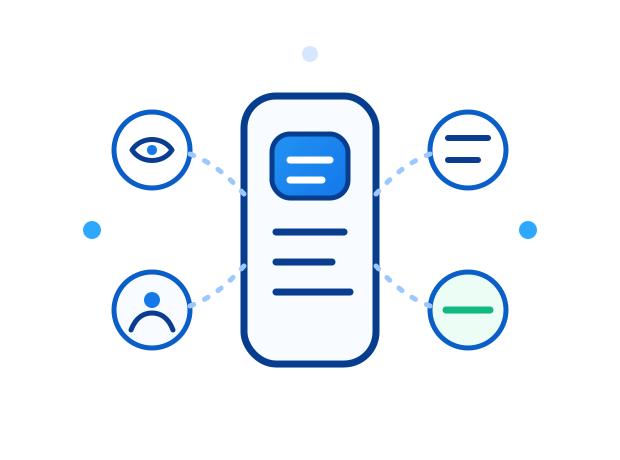
AI agents are appearing across clouds, SaaS platforms, developer environments, and partner systems—often faster than traditional identity programs can account for them. An inventory is necessary but insufficient: without registration, ownership, and lifecycle on the same foundation that authorizes actions, visibility becomes a report that ages while risk accumulates.
Authoritative agent discovery and registration is emerging as a first common governance workstream for enterprises moving AI agents into production—on the same Identity Fabric that will authorize and prove their actions.
Discovery should begin governance—not end with an inventory.
01
Agent discovery connectors observe candidate agent principals in supported environments and bring their evidence into the Identity Fabric for review, attribution, and enrollment.
02
Federated Agent Identity
When an external agent presents an identity assertion, EmpowerID validates the assertion and establishes a governed local identity, delegation, and lifecycle state before allowing it to act.
Discovery and federated admission evidence converge on one canonical governed identity. The same agent can be searched, reviewed, authorized, audited, quarantined, and retired. Retries and duplicate submissions converge—they do not create parallel identities.
Step 1
Find known, unknown, and externally introduced agent principals.
Step 2
Create a governed identity and associate its owner, origin, purpose, and environment.
Step 3
Record delegation, permitted resources, and lifecycle policy.
Step 4
Apply contextual authorization through the EmpowerID Authorization Service and MCP Gateway.
Step 5
Correlate events and receipts; revoke, quarantine, or retire when necessary.
AI agent discovery begins with inventory—but durable control requires the full fabric chain:
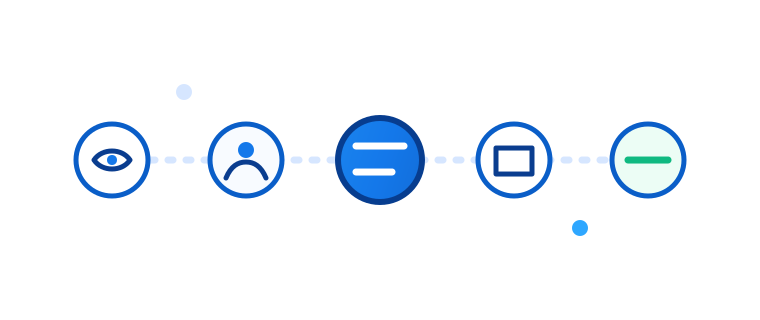
Discovery and registration answer different questions than runtime model and tool enforcement:
The LLM and MCP Gateways do not have to infer who an agent is. They enforce policy using the governed identity, owner, and delegated authority established by the Identity Fabric.
Microsoft Entra, Okta, and Google Cloud discovery and federation paths are available for selected configurations. Connector coverage, operator workflows, and federation modes vary by deployment.
Discovery pipeline and federated agent identity for supported configurations. Full Graph enumeration depends on administrator consent and reader permissions—work with EmpowerID to align scope for your tenant.
Agent discovery connectors and federated agent identity paths for selected configurations.
Agent discovery and federated agent identity for selected Vertex governed-invocation paths and workload-identity federation callbacks—confirm which mode applies to your deployment.
Contact EmpowerID to align provider-specific scope with your environment.
AI Agent Discovery is a Fabric capability, not a separate product SKU. Agent Governance & Execution is the commercial product surface for governed agent action. Feature availability—including discovery connectors, federated agent identity modes, operator workflows, and evidence coverage—varies by edition, deployment, and provider permissions.
AI-agent discovery finds agent principals operating in your environment—through agent discovery connectors and federated admission—and brings their evidence into the Identity Fabric so security and identity teams can see what exists before authorizing action.
Inventory tells you a principal was observed. Registration creates a governed identity with owner, origin, lifecycle state, and policy context—the starting point for delegation, authorization, and audit—not a static catalog entry.
Yes, on supported paths. Agent discovery connectors observe principals in connected systems. Federated Agent Identity governs agents that arrive with external identity assertions—materializing a local governed identity before action.
When an external agent presents a validated assertion, EmpowerID establishes a governed local identity, records delegation where applicable, and enrolls the agent through the same lifecycle controls used for native agents—without treating the foreign token as ambient authority.
Discovery and registration establish who the agent is and who delegated authority. The LLM Gateway enforces whether a specific model call may proceed now. The MCP Gateway enforces whether a specific tool invocation may proceed now. All three use the same Identity Fabric graph and Governed Authorization decision authority.
EmpowerID supports selected Microsoft Entra, Okta, and Google Cloud discovery and federation paths. Scope varies by connector, permissions, and deployment—EmpowerID can walk through tested configurations for your environment.

Online
Powered by EmpowerID AI