
LLM Gateway
Early Access- Identity / delegation
- Fabric identity and policy context
- Control moment
- Before model access
- Limitation
- Features follow the release contract
Agent Governance & Execution
Bind each agent to an accountable identity, approved mission, delegated authority, and current policy. On governed paths, re-authorize the exact proposed action before dispatch, keep destination credentials outside the agent runtime, and preserve evidence through the observed result.
On whose authority did this agent act—and can you prove it?
Early Access. Capabilities, credential modes, and evidence coverage vary by execution path, integration, and release.
Authentication establishes the acting identity. A gateway can limit which tools it may reach. Neither, by itself, establishes that the proposed operation, resource, parameters, destination, and budget still fit the approved mission when the agent is ready to cause change.
Between standing permission and external effect, delegation can change, risk can rise, action details can drift, reusable credentials can be exposed, and an ambiguous target response can make retries unsafe.
A permit is not an effect.

Delegation, ownership, trust, or risk changes mid-run.
The prepared action no longer matches what was approved.
A reusable destination credential reaches the agent.
A timeout hides whether the target changed.
EmpowerID governs this gap on declared execution paths.
An approved mission is the bounded work an agent is authorized to carry out—its purpose, scope, lifecycle, and accountable authority. On a governed path, EmpowerID combines the acting identity, approved mission, delegation, current signals, policy, tool, operation, resource, parameters, and destination into a bound execution authorization. That authority is consumed before dispatch. If the binding fails or authority has changed, the request does not reach the target through that path.
Connect the agent to its accountable owner, delegator, approved mission, authority ceiling, lifecycle, and applicable policy.
Resolve the exact tool, operation, resource, parameters, destination, and expected control requirements.
Evaluate the proposed action through EmpowerID Governed Authorization using current identity, relationship, delegation, risk, and environmental context.
Consume the execution authorization, retrieve the permitted destination credential inside the governed boundary, shape the request, and dispatch only the approved action.
Record the decision, dispatch, target contact, and observed result. Preserve unknown and disputed states rather than treating every timeout as a safe retry.
Obligations are policy-attached requirements—approvals, constraints, logging, or step-up assurance—that must be satisfied for the action to proceed.

The destination credential appears only inside the governed boundary—never in the agent or mission stage.
Execution control, credential mode, idempotency, reconciliation, and evidence depth depend on the declared path and destination capabilities.
An active token is not continuing authority. On governed paths, the next proposed action is re-evaluated against current delegation, policy, and signals before the destination is contacted.
Denial evidence recorded
The operator sees the changed signal, decision, blocked dispatch, and evidence in one causal sequence.
Illustrative product sequence using a governed execution path. Final public artwork must be reconciled against a verified demo capture and receipt schema.
On supported vault-backed paths, the agent asks EmpowerID to perform an authorized action. The destination credential remains inside the governed execution boundary, is applied only after the action is authorized, and is not returned to the agent runtime.
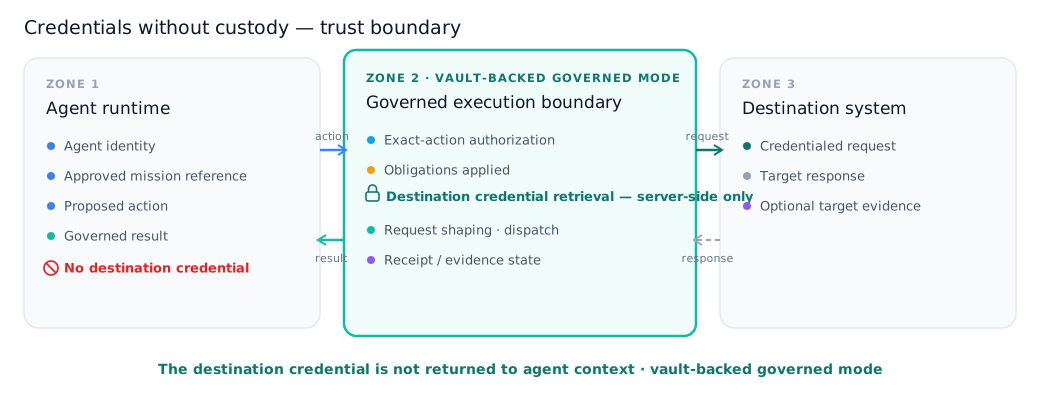
The destination credential is not returned to agent context · vault-backed governed mode
Credential non-custody applies to declared vault-backed modes. Other integration modes must state how credentials are obtained, stored, and exposed.
Explore Credentials Without Custody →Agent Governance & Execution connects the context required to authorize work with the controls required to govern its effects.
Connect agent identity to ownership, sponsorship, lineage, and the authority it operates on.
Define the approved mission, authority ceiling, and the conditions under which work may continue.
Evaluate the proposed operation in context and enforce the decision at a declared boundary.
Connect the authority chain to decisions, dispatch, observed results, and operator controls.
Need to identify agents, owners, reach, and credential paths first? Start with AI Agent Discovery and Registration.
Explore AI Agent Discovery →A model invocation and an enterprise tool call have different risk shapes. EmpowerID keeps the logical authorization plane shared while applying control through the boundary appropriate to each path.
Coverage varies by release, runtime, integration, connector, credential mode, and declared enforcement path. Governed paths are explicit: EmpowerID does not claim control over actions that bypass its declared enforcement points.
Logs, metrics, traces, and alerts remain essential for operations. On covered paths, EmpowerID receipts preserve tamper-evident evidence connecting the request, current authorization decision, dispatch state, and observed result. Strong proof of an external business effect requires trustworthy target evidence or governed participation from the destination.
A later run of the same action, after delegation was restored—authorized and completed end-to-end.
"Result observed" and "Outcome verified" are different states. Where target evidence is unavailable, the record preserves Unknown rather than implying success.
The acting agent, represented subject, accountable owner, and delegation chain.
The mission, policy, tool, operation, resource, parameters, destination, constraints, and obligations in effect.
The allow, deny, approval, credential, shaping, dispatch, cancellation, or retry decision at the governed boundary.
The target contact, response, observed result, reconciliation state, and any remaining uncertainty.
Do not collapse "dispatched," "target contacted," "response observed," and "business effect verified" into one generic success state.
Agent Teams extends Agent Governance & Execution to scheduled and heartbeat-driven work. Governed charters define purpose and roles; deterministic run stages structure execution; human confirmation gates consequential steps; fleet controls pause or terminate operations; and the governance timeline links covered-path evidence over time.
The model contributes intelligence. EmpowerID governs the operating lifecycle.
Agent Teams is Early Access. Coverage varies by release, deployment, and connected systems.
Operator controls shown for illustration; availability varies by release.
EmpowerID participates in the architecture you already have. Use existing agent platforms, applications, service-management experiences, MCP clients, model providers, and enterprise systems while adding accountable identity, dynamic authorization, governed execution, and evidence at declared control points.
Identify agents, establish ownership and purpose, understand reach, and select the paths that require runtime control.
Place a high-impact tool, workflow, connector, or destination behind exact-action authorization, credential mediation, and evidence.
Apply durable missions, lifecycle controls, human confirmations, and fleet operations across additional agents and execution paths.
Runtime sets the ceiling. Some paths support full exact-action control. Others support identity, delegation, or start/stop until a governed callback, wrapper, or execution boundary is introduced.
Governed paths are explicit. EmpowerID does not claim control over actions that bypass its declared enforcement points.
Actions, not cognition. EmpowerID governs identity, authority, model access where supported, tool use, workflow transitions, and external effects. It does not claim to make model reasoning truthful, aligned, or wise.
Evidence states what was observed. Revocation stops new governed actions; it does not undo completed effects. External-effect proof depends on trustworthy downstream evidence.
Bring a consequential execution path. We will show how EmpowerID binds it to an approved mission, evaluates current authority, protects the destination credential, controls dispatch, and preserves evidence of what the governed path observed.

Online
Powered by EmpowerID AI