Anonymous authority
A shared provider key becomes the effective identity. The log shows an application called a model—not which person, workload, or delegated agent exercised whose authority.
EmpowerID Identity Fabric · LLM Gateway
Apply identity, delegated authority, prompt intent, model policy, and current spend state before a governed request reaches an LLM provider—then create signed evidence for completed allowed calls.
OpenAI- and Anthropic-compatible routes · Multi-provider control · AuthZEN-compatible policy
Copilots, workflows, and agents now choose models, consume data, and act on behalf of human and machine subjects. Possession of a provider key proves only that a client can reach a provider—not whose business authority is being exercised, or whether that authority permits the current intent.
A shared provider key becomes the effective identity. The log shows an application called a model—not which person, workload, or delegated agent exercised whose authority.
Acceptable-use rules, model approval lists, and data-handling requirements live in documents and ticket workflows while model requests execute continuously, unexamined at runtime.
One person can start an agent loop that makes many invocations; a model choice can change cost by an order of magnitude. The invoice reports it after the money is gone.
May this subject, acting under this authority, use this model for this apparent purpose under current policy and spend conditions — and what verifiable evidence links the decision to the model use that followed?
Classify
Inline prompt classification exports high-confidence intent and data labels to policy—analytics topics stay separate so exploratory taxonomy never becomes an accidental deny engine.
Authorize
AuthZEN-compatible PDP evaluation with subject, delegation status, model, intent labels, estimated cost, and spend state—every candidate model re-authorized, not config-substituted.
Budget
Estimated cost and authoritative consumed spend evaluated before the provider call—deny, clamp tokens, or route to a lower-cost permitted model before charges are incurred.
Prove
Signed, hash-linked receipts for completed allowed calls bind policy context to measured usage and the effective model actually used—not just the one requested.
Multi-provider access, credentials, metrics, retries, rate limits, and operational logs are necessary baseline capabilities. Production systems also need to answer whether a subject may perform an action on a resource under current context.
| Traffic-oriented control | Governed authorization control |
|---|---|
| API key or gateway credential | Human, application, workload, or agent identity — with delegation |
| Route and provider | Model resource and allowed use for this subject and intent |
| Request volume and rate limits | Subject-specific spend state, evaluated before the provider call |
| Static prompt filter | High-confidence intent and data labels supplied to policy |
| Configured fallback model | Model switching in which every candidate is re-authorized by policy |
| Local gateway configuration | Shared policy decision across enforcement points |
| Operational log | Decision-linked, signed evidence for completed allowed use |
Step 1
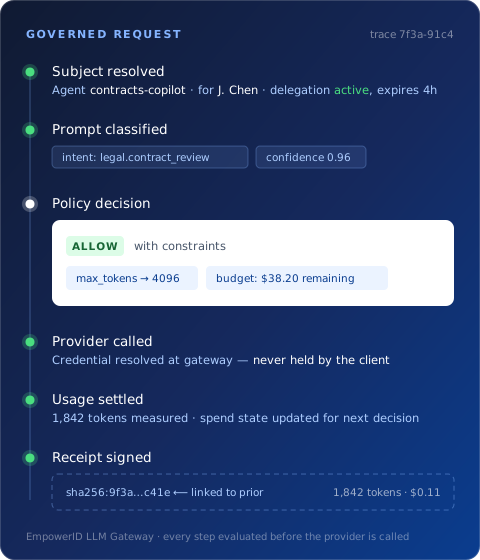
Authenticate through an Identity Fabric session or personal access token; resolve a stable subject and, for agents, the identity chain. A token that names an agent is not enough if delegated authority has expired or does not cover the requested use.
Step 2
Inline prompt classification derives intent and data context. Only allowlisted, high-confidence labels cross the policy export boundary—analytics topics stay out of authorization.
Step 3
Send subject, action, resource, and context—identity chain, delegation status, requested model, intent labels, estimated cost, current spend state—to the AuthZEN-compatible PDP. The answer can be allow, deny, or allow with constraints.
Step 4
A denied request never reaches the provider. An allowed-with-constraints request is narrowed first: clamp maximum tokens, reject an unapproved model, or switch to a permitted model under policy.
Step 5
Organization-managed credentials are resolved from approved vaults and applied only on the upstream provider connection. The client authenticates to the Identity Fabric and never holds the provider key.
Step 6
OpenAI- and Anthropic-compatible routes carry the request body unchanged. Adoption means changing the endpoint and authentication—not rewriting application logic.
Step 7
After a completed allowed call, extract provider usage and settle the spend path. Analytics aggregates consumed spend and exposes it as policy information for the next decision.
Step 8
Completed allowed calls receive signed, hash-linked receipts binding policy context to measured usage—including the effective model actually used. Denied calls use decision telemetry, not receipt-backed execution claims.
The PDP is authoritative for business policy; the gateway is authoritative for enforcement at the model boundary. Every stage can narrow the permitted request—and no stage can widen what the PDP granted.
A standalone gateway can add local rules. An identity-fabric gateway evaluates the same authoritative relationships and logical policy model used everywhere else in the enterprise.
| Typical AI gateway | EmpowerID LLM Gateway |
|---|---|
| API key or virtual key per client | Governed human, application, workload, or agent — with delegation checked at request time |
| Local rules configured in the proxy | The same logical PDP that governs human and workload access, via OpenID AuthZEN |
| Static filters and blocklists | High-confidence intent and data labels exported to policy; analytics topics kept separate |
| Token quotas and after-the-fact dashboards | Estimated cost and authoritative spend state evaluated in the decision, before the call |
| Config fallback or latency-based auto-router | Policy reroute, budget downgrade, provider failover — every candidate re-authorized |
| Gateway holds keys; clients hold gateway keys | Vault-backed organization keys; clients authenticate with Fabric sessions or PATs only |
| Operational logs and metrics | Signed, hash-linked receipts binding decision, constraints, effective model, and usage |
A rate limit answers how often a credential may be used. A budget policy answers whether a specific user, application, or delegated agent may consume a model under a time-bound financial boundary.
Authorization uses the pre-call estimate. A streamed response is not truncated mid-completion—a subject near a hard limit can overshoot by at most one completion’s difference between estimate and actual. Settlement records the overage; the next request is denied against it.
Most gateways substitute a model through config fallback or auto-router—substituting away authorization. In the EmpowerID design, every candidate model is re-evaluated by the PDP before it is used.
Requested model denied for this subject or intent—the first PDP-authorized candidate from the cost-sorted allowed list serves the unchanged request.
Estimate breaches the spend boundary—cheaper allowed models are tried instead of a quota error. A use case pinned to one approved model is denied, never downgraded.
Provider errors or timeouts—circuit breakers move the request only where policy permits. Availability never overrides data, regional, or subject restrictions.
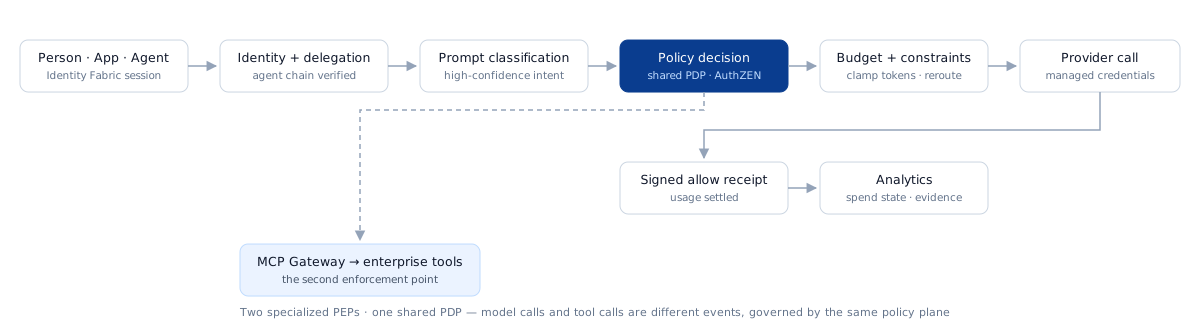
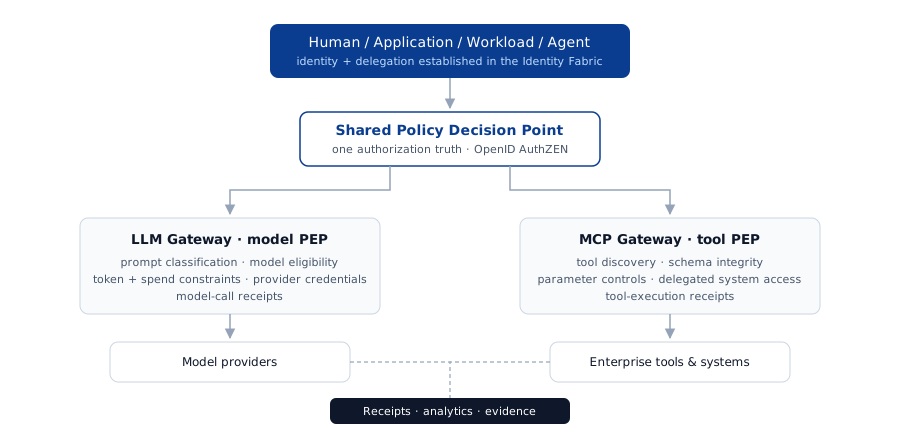
A model invocation and an enterprise tool call have different risk shapes. The Identity Fabric keeps the decision shared and the enforcement specialized.
| Concern | LLM Gateway | MCP Gateway |
|---|---|---|
| Human, workload, and agent identity; delegation; shared PDP | Yes | Yes |
| Prompt classification; model and token constraints; AI budgets; model switching | Owner | — |
| Model-provider credential injection; model-call receipts | Owner | — |
| Tool discovery scoping; schema pins; parameter constraints | — | Owner |
| Enterprise connector credentials; tool-execution receipts | — | Owner |
No silent bypass of authorization; any last-known-good window is bounded and explicit
A limited subject is never assumed to have unlimited funds — fail closed on hard boundaries
Labels required by policy do not become an implicit allow when the classifier is down
Failover moves the request only to alternatives policy permits — never around policy
The PDP is on the hot path: a policy reroute across an allow-list of N candidates costs up to 1 + N evaluations for one user request. Entitlement caching for non-sensitive repeat decisions and deliberately narrow allow-lists keep that bounded.
The gateway governs the routed path; it cannot govern a developer calling a provider directly on a personal key. It belongs in a stack with egress allow-listing and provider-key governance that make the governed route the practical one—not merely the recommended one.
Signed, hash-linked receipts make alteration detectable within the retained chain—tamper-evident, not immutable. A receipt proves the recorded decision-and-usage path has cryptographic integrity; it does not certify that the model output was correct, safe, or compliant.
Can it distinguish people, applications, workloads, and agents — and require active, scoped delegation behind an agent, rather than treating a key as the identity?
Is model authorization evaluated by a shared PDP with subject, intent, data, and spend context — or duplicated as local rules in each gateway?
Can a budget stop or constrain a request before provider consumption — and what happens when the authoritative spend state is unavailable?
Are prompt classifications separated into analytics and policy tiers — with the classifier advisory to policy, observable for drift, and never the business-decision engine?
Can a completed allowed call be linked to its policy decision, constraints, effective model, and measured usage in signed, tamper-evident form?
The LLM Gateway exposes provider-compatible routes for common OpenAI and Anthropic request patterns. Applications authenticate through the Identity Fabric and point their SDK at the governed endpoint—the request body can remain unchanged while authorization, credentials, provider selection, budget policy, and evidence move into a shared control layer.
Give internal copilots controlled access to approved providers and models without distributing provider keys to each application or browser client.
Require an active identity chain and delegated authority before an agent invokes a model, then attribute usage to the governed subject.
Use high-confidence prompt labels as policy inputs to distinguish a permitted general business question from a restricted request about an individual or protected data.
Evaluate current budget state before provider consumption, constrain requested tokens, or route to a lower-cost allowed model under policy.
Bind completed allowed model use to signed receipts and analytics so investigators can reconstruct the decision, constraints, effective model, and usage path.
Identity Provider and credentials
Authenticate principals, issue sessions, support identity chaining
Governed Authorization
PDP evaluation through AuthZEN-compatible interfaces
Identity graph and membership
Agent, user, delegation, and organization relationships
LLM Gateway
Model PEP—classification, budget, provider credentials, and allow-path receipts
MCP Gateway
Tool PEP at discovery and invocation; credential protection and routing
Agent Governance & Execution
Broader agent controls beyond model and tool boundaries
Credible AI governance requires defense in depth. LLM Gateway focuses on identity, authorization, spend, credentials, and allow-path evidence at the model boundary.
Feature availability—including prompt classification depth, budget enforcement modes, model switching paths, provider routes, receipt coverage, circuit breaker behavior, and edition packaging—varies by release and deployment. Confirm scope with EmpowerID before customer-specific commitments.
No. The IdP and LLM Gateway are distinct services within the EmpowerID Identity Fabric. The IdP establishes identity and delegation context. The policy decision point evaluates access. The LLM Gateway enforces the resulting decision at the model boundary.
Inline classification derives intent and data context. Only high-precision intent labels on an allowlist enter PDP context; broad topic labels stay in analytics to prevent false-positive denials. Safety labels can fail closed at the gateway when configured; business rules are PDP decisions with structured advice.
Before the provider call, the gateway estimates cost and presents it with subject attribution to the PDP. Policy compares limits to authoritative consumed spend. Over-budget calls are denied before reaching the model. If spend state is unavailable, hard budgets fail closed for limited subjects.
The LLM Gateway governs model calls. The EmpowerID MCP Gateway separately governs tool calls. The two enforcement points share identity and policy context on one policy plane.
No. Clients authenticate through the Identity Fabric. Organization-managed provider credentials are resolved at the gateway and used only on the provider connection.
Signed receipts are created for completed allowed calls. Denied LLM calls do not currently receive signed receipts and should be represented through decision and operational telemetry—not described as receipt-backed execution.
Policy may reroute to another PDP-authorized candidate, downgrade to a cheaper allowed model when budget blocks the primary, or fail over to another permitted provider. Every substitute is re-authorized by policy—not substituted by configuration alone.
Today the gateway focuses on request classification, policy enforcement, model and token constraints, provider control, and allow-path receipts. Output quarantine and universal response scanning are not part of the current LLM Gateway scope.
Online
Powered by EmpowerID AI